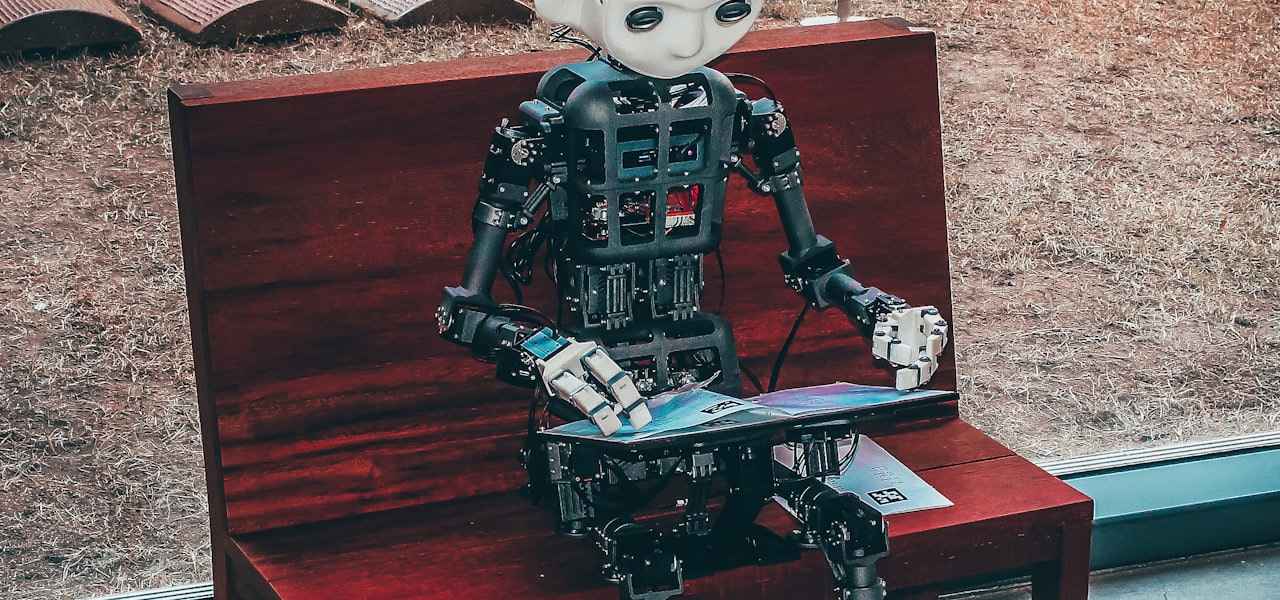
In artificial intelligence, an embodied agent, also sometimes referred to as an interface agent, is an intelligent agent that interacts with the environment through a physical body within that environment. Agents that are represented graphically with a body, for example a human or a cartoon animal, are also called embodied agents, although they have only virtual, not physical, embodiment. A branch of artificial intelligence focuses on empowering such agents to interact autonomously with human beings and the environment. Mobile robots are one example of physically embodied agents; Ananova and Microsoft Agent are examples of graphically embodied agents. Embodied conversational agents are embodied agents (usually with a graphical front-end as opposed to a robotic body) that are capable of engaging in conversation with one another and with humans employing the same verbal and nonverbal means that humans do (such as gesture, facial expression, and so forth). == Embodied conversational agents == Embodied conversational agents are a form of intelligent user interface. Graphically embodied agents aim to unite gesture, facial expression and speech to enable face-to-face communication with users, providing a powerful means of human-computer interaction. == Advantages == Face-to-face communication allows communication protocols that give a much richer communication channel than other means of communicating. It enables pragmatic communication acts such as conversational turn-taking, facial expression of emotions, information structure and emphasis, visualization and iconic gestures, and orientation in a three-dimensional environment. This communication takes place through both verbal and non-verbal channels such as gaze, gesture, spoken intonation and body posture. Research has found that users prefer a non-verbal visual indication of an embodied system's internal state to a verbal indication, demonstrating the value of additional non-verbal communication channels. As well as this, the face-to-face communication involved in interacting with an embodied agent can be conducted alongside another task without distracting the human participants, instead improving the enjoyment of such an interaction. Furthermore, the use of an embodied presentation agent results in improved recall of the presented information. Embodied agents also provide a social dimension to the interaction. Humans willingly ascribe social awareness to computers, and thus interaction with embodied agents follows social conventions, similar to human to human interactions. This social interaction both raises the believably and perceived trustworthiness of agents, and increases the user's engagement with the system. Rickenberg and Reeves found that the presence of an embodied agent on a website increased the level of user trust in that website, but also increased users' anxiety and affected their performance, as if they were being watched by a real human. Another effect of the social aspect of agents is that presentations given by an embodied agent are perceived as being more entertaining and less difficult than similar presentations given without an agent. Research shows that perceived enjoyment, followed by perceived usefulness and ease of use, is the major factor influencing user adoption of embodied agents. A study in January 2004 by Byron Reeves at Stanford demonstrated how digital characters could "enhance online experiences" through explaining how virtual characters essentially add a sense of familiarity to the user experience and make it more approachable. This increase in likability in turn helps make the products better, which benefits both the end users and those creating the product. === Applications === The rich style of communication that characterizes human conversation makes conversational interaction with embodied conversational agents ideal for many non-traditional interaction tasks. A familiar application of graphically embodied agents is computer games; embodied agents are ideal for this setting because the richer communication style makes interacting with the agent enjoyable. Embodied conversational agents have also been used in virtual training environments, portable personal navigation guides, interactive fiction and storytelling systems, interactive online characters and automated presenters and commentators. Major virtual assistants like Siri, Amazon Alexa and Google Assistant do not come with any visual embodied representation, which is believed to limit the sense of human presence by users. The U.S. Department of Defense utilizes a software agent called SGT STAR on U.S. Army-run Web sites and Web applications for site navigation, recruitment and propaganda purposes. Sgt. Star is run by the Army Marketing and Research Group, a division operated directly from The Pentagon. Sgt. Star is based upon the ActiveSentry technology developed by Next IT, a Washington-based information technology services company. Other such bots in the Sgt. Star "family" are utilized by the Federal Bureau of Investigation and the Central Intelligence Agency for intelligence gathering purposes.
Text Database and Dictionary of Classic Mayan
The project Text Database and Dictionary of Classic Mayan (abbr. TWKM) promotes research on the writing and language of pre-Hispanic Maya culture. It is housed in the Faculty of Arts at the University of Bonn and was established with funding from the North Rhine-Westphalian Academy of Sciences, Humanities and the Arts. The project has a projected run-time of fifteen years and is directed by Nikolai Grube from the Department of Anthropology of the Americas at the University of Bonn. The goal of the project is to conduct computer-based studies of all extant Maya hieroglyphic texts from an epigraphic and cultural-historical standpoint, and to produce and publish a database and a comprehensive dictionary of the Classic Mayan language. == Subject of the Project == The text database, as well as the dictionary that will be compiled by the conclusion of the project, will be assembled based on all known texts from the pre-Hispanic Maya culture. These texts were produced and used between approximately the third century B.C. through A.D. 1500, in a region that today includes parts of the countries of Mexico, Guatemala, Belize, and Honduras. The thousands of hieroglyphic inscriptions on monuments, ceramics, or daily objects that have survived into the present offer insight into the language's vocabulary and structure. The project's database and dictionary will digitally represent original spellings using the logo-syllabic Maya hieroglyphs, as well as their transcription and transliteration in the Roman alphabet. The data will be additionally annotated with various epigraphic analyses, translations, and further object-specific information. == Project Partners == TWKM will employ digital technologies in order to compile and make available the data and metadata, as well as to publish the project's research results. The project thereby methodologically positions itself in the field of the digital humanities. The project will be conducted in cooperation with the project partners (below), the research association for the eHumanities TextGrid, as well as the University and Regional Library of Bonn (ULB). The working environment that is currently under construction, in which the data and metadata will be compiled and annotated, will be realized in theTextGrid Laboratory, a software of the virtual research environment. A further component of this software, the TextGrid Repository, will make the data that are authorized for publication freely available online and ensure their long-term storage. The tools for data compilation and annotation attained from the modularly constructed and extended TextGrid lab thereby provide all the necessary materials for facilitating the research team's the typical epigraphic workflow. The workflow usually begins by documenting the texts and the objects on which they are preserved, and by compiling descriptive data. It then continues with the various levels of epigraphic and linguistic analysis, and concludes in the best case scenario with a translation of the analyzed inscription and a corresponding publication. In cooperation with the ULB, selected data will additionally be made available. The project's Virtual Inscription Archive will present online, in the Digital Collections of the ULB, hieroglyphic inscriptions selected from the published data in the repository, including an image of and brief information about the texts and the objects on which they are written, epigraphic analysis, and translation. == Project Goal == One of the project's goals is to produce a dictionary of Classic Mayan, in both digital and print form, towards the end of the project run-time. Additionally, a database with a corpus of inscriptions, including their translations and epigraphic analyses, will be made freely available online. The database furthermore will provide an ontology-like link of the contextual object data with the inscriptions and with each other, thereby allowing a cultural-historical arrangement of all contents within the periods of pre-Hispanic Maya culture. The contents of the database are additionally linked to citations of relevant literature. As a result, the database will also make freely available to both the scientific community and other interested parties a bibliography representing the research history and a base of knowledge concerning ancient Maya culture and script. In addition, the Classic Maya script, in its temporally defined stages of language development, will be gathered into and documented in a comprehensive language corpus with the aid of the information gathered by the project. In collaboration with all project participants, the corpus data can be used, together with the aid of various comparable analyses and also computational linguistic methods, such as inference-based methods, to confirm readings of some hieroglyphs that are currently only partially confirmed, and to eventually completely decipher the Classic Maya script.
RagTime
RagTime is a frame-oriented business publishing software which combines word processing, spreadsheets, simple drawings, image processing, and charts, in a single document/program, integrated software. It is often used to create forms, reports, documentation, desktop publishing, and in office environments. Typical users are business clients, educational institutions, administrations, architects, and also private users. Ragtime includes the following modules: Page layout (forms, templates etc.) Word processing Image processing Spreadsheets, similar to Microsoft Excel Formulas and functions which can be used throughout, in text, graphics, and spreadsheets Charts in different types of diagrams Drawings in vector graphics including lines, polygons, Bézier curves and more Slide show (presentation of RagTime documents) Audio/video Buttons (pop-up menus, switches, and more) that can be used within RagTime documents Import/export of various file formats Support of the AppleScript scripting language available system-wide under macOS == Principle == RagTime differs from most other comparable programs or software packages in its strict frame-oriented design: all content is contained within frames on each page. The content can have a fixed position within its frame or, if it is text or a spreadsheet, flow into another frame that is connected to the first frame via a so-called “pipeline”. RagTime has no different document types for different types of data; all content is stored in a single compound document type. Thus, a RagTime document not only can contain multiple pages, but also multiple layouts within the same document; e.g. spreadsheets in addition to text and images. The RagTime filename extension is .rtd (RagTime document); for templates the extension is .rtt (RagTime template). The current version is RagTime 6.6.5. It is available for OS X (10.6-10.14) and Windows (XP/Vista/7/8/10). == Extensions == FileTime – allows accessing “FileMaker Pro” databases from RagTime documents under OS X RagTime Connect – ODBC database connection for RagTime 6 (Mac and Windows) Johannes – print extension for the simple creation of stapled or folded brochures, booklets etc. PowerFunctions – additional functions for a more effective creation of intelligent documents for exchanging data and for use in mixed Mac/Windows environments MetaFormula – SYLK-based extension that allows calculating text as formula == History == RagTime has been developed since 1985 for the Macintosh – originally named MacFrame – and was published in 1986. When released, it already had the present name, which was chosen following the then-available software package Lotus Jazz. In the European Macintosh market, RagTime quickly gained a prominent position that continues to this day, even though the market share has decreased. Despite repeated attempts, the program could not gain acceptance in the North American market due to its high cost ($395 in 1990). The North American sales office closed in 1991, shortly after Claris Corporation released ClarisWorks which duplicated much of the functionality of RagTime for a lower price. After the manufacturer – first Brüning & Everth, followed by B&E Software and today RagTime.de Development – had focused on the Macintosh only for a very long time, it also released a Windows version, RagTime 5.0, in 1999. However, the program could not assume great significance against established competitors, especially Microsoft Office. Until mid-2006 RagTime was, in addition to the commercial version, also available as a free version (RagTime Solo) for personal use. RagTime Solo included the same features and performance (except for spelling and Syllabification) dictionaries), but was not allowed for use in commercial environments. In other languages RagTime Solo was distributed as RagTime Privat. In a press release from July 5, 2006, RagTime announced the discontinuation of RagTime Solo: “… the RagTime Solo license conditions were often misinterpreted or deliberately flouted. Therefore we discontinued RagTime Solo, there will be no private version of RagTime 6 anymore.” After a successful start of the RagTime 6.0 software, sales edged significantly lower in the following years. Disagreements arose among the shareholders about the continuation of the company, which filed for bankruptcy in July 2007. As a result, the rights to RagTime were taken over by the newly established company RagTime.de Development GmbH, which was responsible for the development. The sales partner RagTime.de Sales GmbH distributed the RagTime products until October 2015. Today RagTime.de Development GmbH is also responsible for sales. The last level of development is the extensively revamped version RagTime 6.6 of 8 October 2015, which also includes new OS X features (e.g. high-resolution “Retina” displays) and supports Windows 10. == Programming == RagTime 1-3 were developed in Pascal, since version 4 the development is completely coded in C++. External programming and automation can be implemented via AppleScript on a Mac, and via OLE/COM-API (e.g. Visual Basic) under Windows. On a Mac, RagTime provides a comprehensive AppleScript library, for the automation of almost any task, from automatic document creation to the export of PDF documents. RagTime also supports “recordings” by use of the “AppleScript Editor”, which allows recording the interactive RagTime operation as an AppleScript program sequence. AppleScripts can be saved in the RagTime document and called via menu or shortcut keys. On Windows, RagTime (since version 6) disposes over an OLE/COM API, which allows automating many RagTime components via external programming. For that purpose there is a type library that installs the available RagTime OLE/COM object catalogue. Programming can be realized in all programming languages supported by Microsoft.
Act! LLC
ACT! (previously known as Activity Control Technology, Automated Contact Tracking, ACT! by Sage, and Sage ACT!) is a customer relationship management and marketing automation software platform designed for small and medium-sized businesses. It has over 2.8 million registered users as of December 2014. == History == The company Conductor Software was founded in 1986, in Dallas, Texas, by Pat Sullivan and Mike Muhney. The original name for the software was Activity Control Technology; it was renamed to Automated Contact Tracking, later abbreviated to ACT. The name of the company was subsequently changed to Contact Software International and it was sold in 1993 to Symantec Corporation, who in 1999 then sold it to SalesLogix. The Sage Group purchased Interact Commerce (formerly SalesLogix) in 2001 through Best Software, then its North American software division. Swiftpage acquired it in 2013. Beginning with the 2006 version, the name was styled ACT! by Sage, and in 2010 revised to Sage ACT!. Following its 2013 acquisition by Swiftpage, it was renamed to ACT! Swiftpage. In May 2018, ACT! was sold to SFW Advisors. In December 2018, Kuvana, a marketing automation software solution, was acquired by SFW and merged with ACT! This add-on is now a complementary service to the core CRM solution. In December 2019, ACT! hired Steve Oriola as chairman and CEO. In 2020, Swiftpage changed its company name to ACT!. In March 2023, ACT! hired Bruce Reading as President and CEO. == Software == ACT! features include contact, company and opportunity management, a calendar, marketing automation and e-marketing tools, reports, interactive dashboards with graphical visualizations, and the ability to track prospective customers. ACT! integrates with Microsoft Word, Excel, Outlook, Google Contacts, Gmail, and other applications via Zapier. For custom integrations, ACT! has an in-built API. ACT! can be accessed from Windows desktops (Win7 and later) with local or network shared database; synchronized to laptops or remote officers; Citrix or Remote Desktop; Web browsers (Premium only) with self or SaaS hosting; smartphones and tablets via HTML5 Web (Premium only); smartphones and tablets via sync with Handheld Contact.
NeoPaint
NeoPaint is a raster graphics editor for Windows and MS-DOS. It supports several file formats including JPEG, GIF, BMP, PNG, and TIFF. The developer, NeoSoft, advertises NeoPaint as "being simple enough for use by children while remaining powerful enough for the purposes of advanced image editing". The first version, NeoPaint 1.0, was released in 1992 on floppy disks. It supported video modes ranging from 640x350 to 1024x768 and multiple fonts. NeoPaint 2.2 came out for MS-DOS 3.1 in 1993, with support of for 2, 16, or 256 color images in Hercules, EGA, VGA, and Super VGA modes. NeoPaint 3.1 was released in 1995 supporting 24-bit images and formats like PCX, TIFF and BMP. NeoPaint 3.2 was released in 1996. An updated version, NeoPaint 3.2a, supported the GIF file format. NeoPaint 3.2d was released in 1998. A Windows 95 version named NeoPaint for Windows v4.0 was released in 1999 supporting the PNG file format. On September 1, 2018 the program was rebranded as PixelNEO, becoming one of the VisualNEO software products. Formats such as JPEG 2000, ICO, CUR, PSD and RAW are supported.
80 Million Tiny Images
80 Million Tiny Images is a dataset intended for training machine-learning systems constructed by Antonio Torralba, Rob Fergus, and William T. Freeman in a collaboration between MIT and New York University. It was published in 2008. The dataset has size 760 GB. It contains 79,302,017 32×32-pixel color images, scaled down from images scraped from the World Wide Web over 8 months. The images are classified into 75,062 classes. Each class is a non-abstract noun in WordNet. Images may appear in more than one class. The dataset was motivated by non-parametric models of neural activations in the visual cortex upon seeing images. The CIFAR-10 dataset uses a subset of the images in this dataset, but with independently generated labels, as the original labels were not reliable. The CIFAR-10 set has 6000 examples of each of 10 classes, and the CIFAR-100 set has 600 examples of each of 100 non-overlapping classes. == Construction == It was first reported in a technical report in April 2007, during the middle of the construction process, when there were only 73 million images. The full dataset was published in 2008. They began with all 75,846 non-abstract nouns in WordNet, and then for each of these nouns, they scraped 7 image search engines: Altavista, Ask.com, Flickr, Cydral, Google, Picsearch, and Webshots. After 8 months of scraping, they obtained 97,245,098 images. Since they did not have enough storage, they downsized the images to 32×32 as they were scraped. After gathering, they removed images with zero variance and intra-word duplicate images, resulting in the final dataset. Out of the 75,846 nouns, only 75,062 classes had any results, so the other nouns did not appear in the final dataset. The number of images per noun follows a Zipf-like distribution, with 1056 images per noun on average. To prevent a few nouns taking up too many images, they put an upper bound of at most 3000 images per noun. == Retirement == The 80 Million Tiny Images dataset was retired from use by its creators in 2020, after a paper by researchers Abeba Birhane and Vinay Prabhu found that some of the labeling of several publicly available image datasets, including 80 Million Tiny Images, contained racist and misogynistic slurs which were causing models trained on them to exhibit racial and sexual bias. The dataset also contained offensive images. Following the release of the paper, the dataset's creators removed the dataset from distribution, and requested that other researchers not use it for further research and to delete their copies of the dataset.
Lenna
Lenna (or Lena) is a standard test image used in the field of digital image processing, starting in 1973. It is a picture of the Swedish model Lena Forsén, shot by photographer Dwight Hooker and cropped from the centerfold of the November 1972 issue of Playboy magazine. Lenna has attracted controversy because of its subject matter. Starting in the mid-2010s, many journals have deemed it inappropriate and discouraged its use, while others have banned it from publication outright. Forsén herself has called for it to be retired, saying "It's time I retired from tech." The spelling "Lenna" came from the model's desire to encourage the proper pronunciation of her name. "I didn't want to be called Leena [English: ]," she explained. == History == Before Lenna, the first use of a Playboy magazine image to illustrate image processing algorithms was in 1961. Lawrence G. Roberts used two cropped six-bit grayscale facsimile scanned images from Playboy's July 1960 issue featuring Playmate Teddi Smith, in his master's thesis on image dithering at Massachusetts Institute of Technology. Lenna was originally intended for high resolution color image processing study. Its history was described in the May 2001 newsletter of the IEEE Professional Communication Society, in an article by Jamie Hutchinson: Alexander Sawchuk estimates that it was in June or July of 1973 when he, then an assistant professor of electrical engineering at the University of Southern California Signal and Image Processing Institute (SIPI), along with a graduate student and the SIPI lab manager, was hurriedly searching the lab for a good image to scan for a colleague's conference paper. They got tired of their stock of usual test images, dull stuff dating back to television standards work in the early 1960s. They wanted something glossy to ensure good output dynamic range, and they wanted a human face. Just then, somebody happened to walk in with a recent issue of Playboy. The engineers tore away the top third of the centerfold so they could wrap it around the drum of their Muirhead wirephoto scanner, which they had outfitted with analog-to-digital converters (one each for the red, green, and blue channels) and a Hewlett Packard 2100 minicomputer. The Muirhead had a fixed resolution of 100 lines per inch and the engineers wanted a 512×512 image, so they limited the scan to the top 5.12 inches of the picture, effectively cropping it at the subject's shoulders. The image's reach was limited in the 1970s and 80s, which is reflected in it initially only appearing in .org domains, but in July 1991, the image featured on the cover of Optical Engineering alongside Peppers, another popular test image. This drew the attention of Playboy to the potential copyright infringement. The peak of image hits on the internet was in 1995. The scan became one of the most used images in computer history. The use of the photo in electronic imaging has been described as "clearly one of the most important events in [its] history". The image spread to over 100 different domains, particularly .com and .edu. In a 1999 issue of IEEE Transactions on Image Processing "Lena" was used in three separate articles, and the picture continued to appear in scientific journals throughout the beginning of the 21st century. Lenna is so widely accepted in the image processing community that Forsén was a guest at the 50th annual Conference of the Society for Imaging Science and Technology (IS&T) in 1997. In 2015, Lena Forsén was also guest of honor at the banquet of IEEE ICIP 2015. After delivering a speech, she chaired the best paper award ceremony. To explain why the image became a standard in the field, David C. Munson, editor-in-chief of IEEE Transactions on Image Processing, stated that it was a good test image because of its detail, flat regions, shading, and texture. He also noted that "the Lena image is a picture of an attractive woman. It is not surprising that the (mostly male) image processing research community gravitated toward an image that they found attractive." While Playboy often cracks down on illegal uses of its material and did initially send a notice to the publisher of Optical Engineering about its unauthorized use in that publication, over time it has decided to overlook the wide use of Lena. Eileen Kent, VP of new media at Playboy, said, "We decided we should exploit this, because it is a phenomenon." == Criticism == The use of the image has produced controversy because Playboy is "seen (by some) as being degrading to women". In a 1999 essay on reasons for the male predominance in computer science, applied mathematician Dianne P. O'Leary wrote: Suggestive pictures used in lectures on image processing ... convey the message that the lecturer caters to the males only. For example, it is amazing that the "Lena" pin-up image is still used as an example in courses and published as a test image in journals today. A 2012 paper on compressed sensing used a photo of the model Fabio Lanzoni as a test image to draw attention to this issue. The use of the test image at the magnet school Thomas Jefferson High School for Science and Technology in Fairfax County, Virginia, provoked a guest editorial by a senior in The Washington Post in 2015 about its detrimental impact on aspiring female students in computer science. In 2017, the Journal of Modern Optics published an editorial titled "On alternatives to Lenna" suggesting three images (Pirate, Cameraman, and Peppers) that "are reasonably close to Lenna in feature space". In 2018, the Nature Nanotechnology journal announced that they would no longer consider articles using Lenna. In the same year SPIE, the publishers of Optical Engineering, also announced that they "strongly discourage" the use of Lenna, and would no longer consider new submissions containing the image "without convincing scientific justification for its use". They noted that aside from the copyright and ethical issues, that it was also no longer useful as a standard image: "In today's age of high-resolution digital image technology, it seems difficult to argue that a 512 × 512 image produced with a 1970s-era analog scanner is the best we have to offer as an image quality test standard". Forsén stated in the 2019 documentary film Losing Lena, "I retired from modeling a long time ago. It's time I retired from tech, too... Let's commit to losing me." The Institute of Electrical and Electronics Engineers (IEEE) announced that, starting April 1, 2024, it will no longer allow use of Lenna in its publications.